 Språk
Språk
© TicketCo AS 2026.
Juridiska villkor för biljettköpare
Juridiska villkor för arrangörer
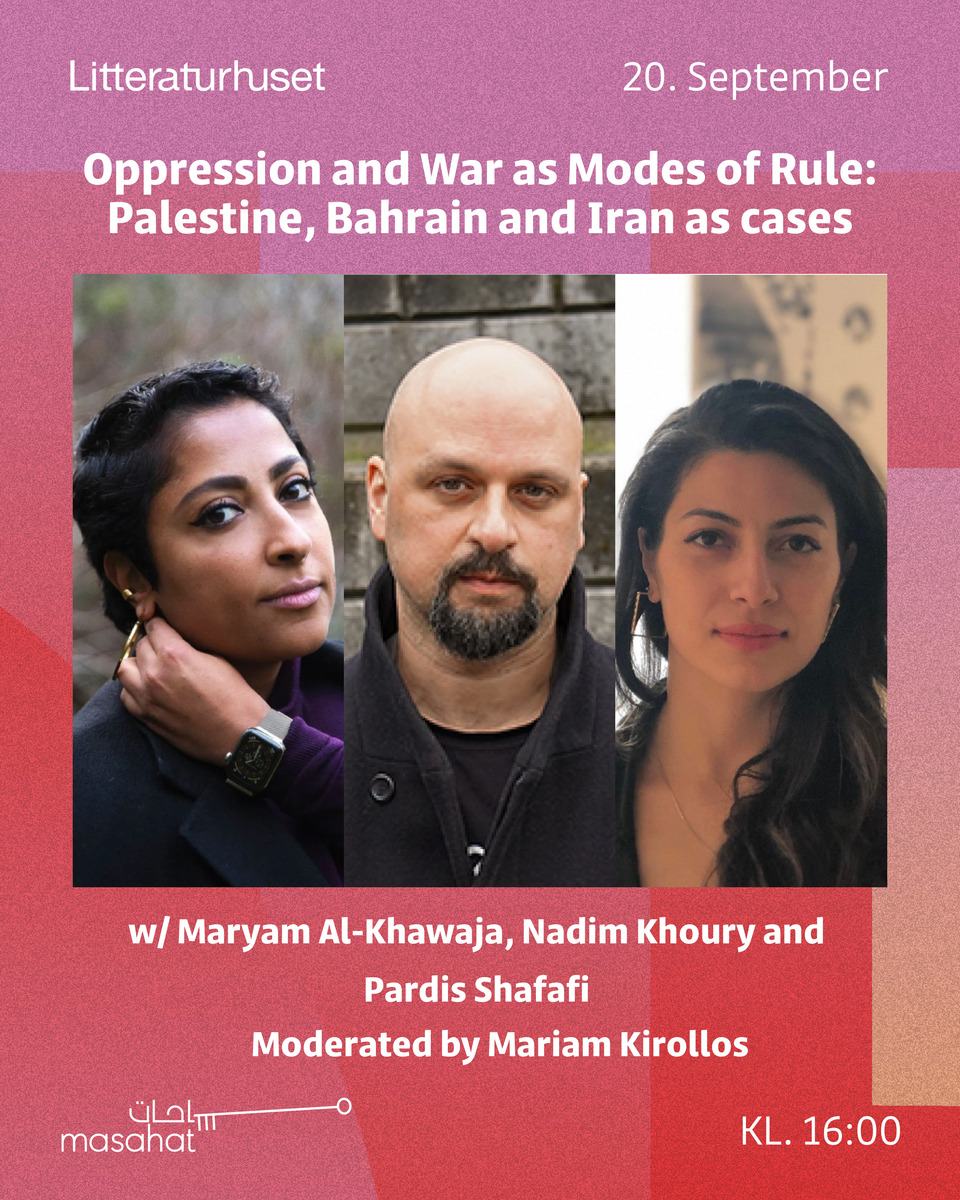
Hvilken rolle spiller undertrykkelse og krig i dagens regionale konflikt mellom USA og Iran?
I deler av debatten blir de pågående konfliktene i Midtøsten ofte redusert til en kamp mellom det gode og det onde. Dagens panel vil utfordre en slik forståelse, og heller se nærmere på hvordan undertrykkelsesmekanismer i ulike deler av regionen ligner hverandre.
Ved å fokusere på hvordan mennesker I regionen fortrenges og fengsles, og diskrimineres på bakgrunn av etnisitet og kjønn, så vel som hvordan undertrykkelse har preget regionen gjennom lange tider, vil panelet undersøke hvordan regimer i regionen har brukt krig og undertrykkelse som verktøy for å berike et fåtall, samtidig som millioner blir fortrengt, eller risikerer fengsel, utradering og mord.
Maryam Al-Khawaja er en dansk-bahrainisk menneskerettsaktivist og en sentral stemme i kampen for menneskerettigheter og politiske endringer i Bahrain og Gulfen. Hun har sittet i styret til blant annet CIVICUS, Bahrain Institute for Rights and Democracy, International Service for Human Rights, og Urgent Action Fund.
Nadim Khoury er en palestinsk forsker fra Øst-Jerusalem. Han er for tiden førsteamanuensis ved Institutt for rettsvitenskap, filosofi og internasjonale studier ved Universitetet i Innlandet, der han underviser i politisk idehistorie og internasjona studier, og forsker på overgangsoppgjør, nasjonalisme og kolonialisme med et særlig fokus på Palestina og Israel .
Pardis Shafafi er en britisk-iransk antropolog tilknyttet Laboratoire d’Anthropologie Politique ved EHESS i Paris, og forsker på statlig vold og politisk undertrykkelse i Iran, historiske minner som våpen og grasrotbevegelser. Huner medredaktør for den kommende boka The Long Iranian Revolution: Counter-Memories, Violence and the Afterlives of 1979 (Bloomsbury, 2026).
Mariam Kirollos er seniorrådgiver for regionen Midtøsten og Nord-Afrika i Amnesty International Norge. Hun har arbeidet med menneskerettsspørsmål knyttet til regionen siden 2008. Nå møter hun Khawaja, Khoury og Shafafi til samtale om situasjonen for folk i Iran, Gulfen, Palestina og Levanten.
//
Oppression and War as Modes of Rule: Palestine, Bahrain and Iran as cases.
In this panel we will examine the similarities between structures of oppression in the region bey
Through a conversation about modes of displacement, incarceration, ethnic and gender discrimination, as well as long histories of oppression, we will discover how regional rule has depended on war and oppression to enrich the few, while millions are displaced, facing imprisonment, erasure and murder.
How do oppression and war feature in today's regional framework conflict between the US and Iran?
Mariam Kirollos (moderator) is a human rights researcher and senior advisor for the Middle East and North Africa at Amnesty International Norway. She holds a Master's degree in International Law from SOAS, University of London, and a Bachelor's degree in Political Science and Sociology from the American University in Cairo. Mariam has worked on various human rights issues in the MENA region since 2008.
Nadim Khoury (panelist) is a Palestinian Academic from occupied East Jerusalem. He is currently an associate professor in international studies at the University of Inland Norway, where he teaches courses on the history of political thought and international relations. Nadim's research interests include memory politics, transitional justice, nationalism, and colonialism, with a focus on Palestine/Israel. He has published on these themes in leading international journals and publications.
Maryam Al-Khawaja (panelist) is a Danish-Bahraini human rights defender and international human rights advocate. She is a leading voice for human rights and political reform in Bahrain and the Gulf region and she has been influential in shaping official responses to human rights atrocities in Bahrain and the Gulf region by leading campaigns and engaging with prominent policymakers around the world. Maryam Al-Khawaja has served on the boards of CIVICUS, Bahrain Institute for Rights and Democracy, International Service for Human Rights, and Urgent Action Fund.
Pardis Shafafi (panelist) is an applied anthropologist and associate researcher at the Laboratoire d’Anthropologie Politique (LAP/EHESS, Paris). Her work confronts Iranian state violence, trauma politics, and systemic impunity, focusing on state-led practices of "enforced forgetting," the weaponisation of historical memory, and grass-roots accountability initiatives.
This work is further developed in her academic publications, notably in the upcoming co-edited volume, The Long Iranian Revolution: Counter-Memories, Violence and the Afterlives of 1979 (Bloomsbury, 2026). Alongside her work on Iran she researches technopolitics as an extension of and new terrain of political struggle.